
Faulty Power Windows – Diagnose Switches Motors and Wiring

A power window that stops moving doesn’t automatically need a new motor. Faulty power windows can result from switches, wiring, fuses, circuit breakers, damaged regulators, poor grounds, or mechanical binding inside the door.
A few observations before removing the door panel can narrow the problem and reduce unnecessary parts replacement.
Compare the Affected Windows First
If every window stops operating at once, look for components shared by the system. A fuse, circuit breaker, master switch, power supply, or ground problem is more likely than several window motors failing simultaneously.
If only one window doesn’t work, operate it from both the local door switch and the driver’s master switch. Different results between the two controls can point toward a switch or wiring issue.
People researching car repair fundamentals can save significant diagnostic time by identifying whether a problem affects one component or the entire circuit.
Listen to What Happens When the Switch Is Pressed
Sound provides important information. A motor noise with no glass movement suggests that electrical power may be reaching the motor while the regulator, cable, track, or mounting hardware has failed.
Complete silence leaves more possibilities. The switch, motor, wiring, power feed, ground, or door-jamb connection may need testing.
Watch for Slow or Uneven Movement
A window that moves slowly, tilts in the opening, or needs assistance may be binding mechanically. Continuing to operate it can place extra load on the motor and regulator.
Inspect weatherstripping and tracks before assuming the motor is weak.
Test the Switch and Motor Circuit
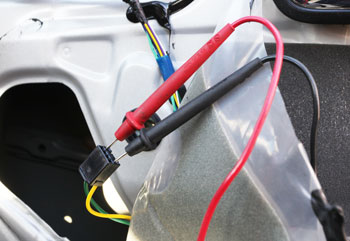
A multimeter or suitable test light can determine whether power reaches the motor when the switch is commanded. Because many power-window motors reverse direction by reversing polarity, testing needs to account for both switch directions.
If voltage and ground reach the motor correctly but it doesn’t operate, the motor becomes a stronger suspect. If power is missing, diagnosis should move backward through the circuit.
A broader understanding of vehicle wiring diagnosis is useful because damaged wiring can imitate component failure.
| Observation | Possible Cause | What to Check |
|---|---|---|
| All windows fail | Shared supply fault | Fuse/master circuit |
| One switch fails | Switch or wiring | Both switch controls |
| Motor runs, glass doesn’t | Regulator failure | Door mechanism |
| Window moves slowly | Binding or resistance | Tracks and voltage |
Inspect Wiring Through the Door Hinge Area
Wires between the body and door flex every time the door opens. Over many cycles, individual conductors can fracture inside the protective rubber boot even when the insulation looks normal externally.
Intermittent operation that changes when the door moves is an especially useful clue. Carefully inspecting and electrically testing this harness can uncover faults that would otherwise lead to unnecessary switch or motor replacement.
Resources covering automotive electrical repairs may provide useful background, but wire repairs should restore proper insulation, flexibility, and conductor integrity.
Why Parts Swapping Wastes Time
A failed power window motor is common enough that replacing it first can seem reasonable. Yet installing a motor won’t fix a broken regulator, damaged door wiring, failed switch, or missing ground.
Door-panel removal also adds labor and creates opportunities to damage clips or trim. Basic circuit testing before disassembly helps determine whether mechanical access is actually necessary.
Frequently Asked Questions
Why does my power window work sometimes?
Intermittent operation can come from worn switch contacts, broken door-harness wiring, a failing motor, or a mechanical mechanism that occasionally binds.
Can a bad window regulator stop the glass from moving?
Yes. The motor may still operate while a broken cable, gear, track, or regulator prevents the glass from moving correctly.
Why does my window work from one switch but not another?
That difference often points toward the nonworking switch or its related wiring. The shared motor is less likely to be the primary fault if another switch operates it normally.
Diagnose Before Removing the Door Panel
Start with the pattern: one window or all of them, silent or noisy, intermittent or completely dead. Then test switches, power, ground, motor operation, and mechanical movement in a logical order.
That approach turns a frustrating power-window failure into a manageable electrical and mechanical diagnosis instead of a guessing exercise.