
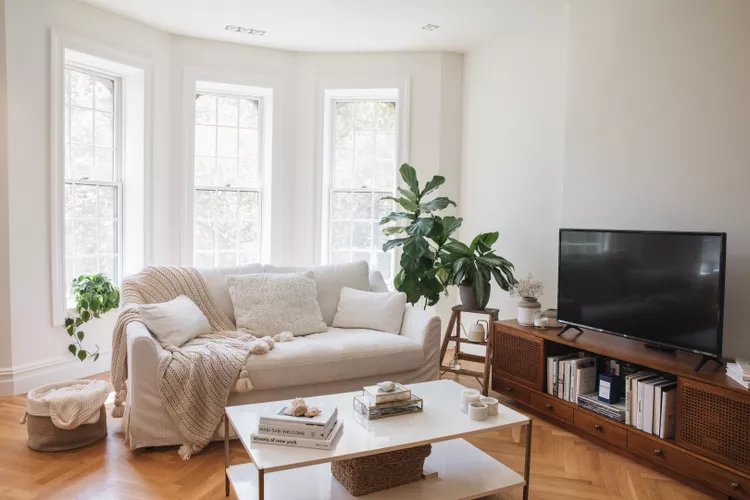
Awkward Furniture Placement – Create Balance and Better Movement

Furniture can fit inside a room and still feel wrong. A sofa may block the natural route, chairs may seem disconnected, or one side of the room may carry far more visual weight than the other. Fixing awkward furniture placement starts by improving relationships between pieces rather than moving everything randomly.
Balance comes from function, spacing, scale, and visual weight working together.
Locate the Room’s Natural Anchor
Most rooms have something that naturally attracts attention: a fireplace, television, window, artwork, bed, dining table, or architectural feature.
Arrange major furniture in response to that anchor. Without a clear relationship, pieces can look as though they were placed wherever space happened to remain.
One Room Can Have More Than One Zone
Large or oddly shaped rooms may need separate functions rather than one oversized furniture arrangement.
A reading chair near a window and a conversation group around the sofa can coexist when each zone has a clear purpose.
Balance Visual Weight, Not Matching Pieces
Balance doesn’t require identical furniture on both sides of the room. A large sofa might be visually balanced by two lighter chairs, a floor lamp, and artwork.
Examples of balanced interior layouts often show asymmetrical arrangements that still feel stable because size, height, and spacing are carefully distributed.
| Placement Problem | Likely Cause | Better Direction |
|---|---|---|
| Heavy on one side | Uneven scale | Redistribute height |
| Chairs feel separate | Too much distance | Tighten grouping |
| Walkway feels blocked | Furniture in route | Shift main piece |
| Room feels scattered | No anchor | Establish focal point |
Adjust Conversation Distance
Seats positioned too far apart make a room feel disconnected. Moving them slightly closer can transform separate objects into a recognizable seating group.
The arrangement should also support comfort. Ideas associated with inviting living spaces tend to work because tables, lamps, and seating are positioned around actual human use rather than decorative symmetry.
Give Tables a Clear Job
Side tables and coffee tables should be reachable from nearby seating. If a table sits in an empty gap only because the room looked unfinished, reconsider its position.
Functional placement almost always appears more natural.
Use Open Space as Part of the Layout
An empty section of floor doesn’t need to be filled. Open areas can separate zones, emphasize an architectural feature, or provide comfortable circulation.
The same principle appears in outdoor furniture arrangements, where spaces between seating groups often make the entire setting easier to move through and visually calmer.
Don’t Keep Moving Small Pieces First
A common mistake is repeatedly shifting lamps, tables, stools, and accessories while leaving the oversized sofa or cabinet untouched. Large furniture determines the basic structure.
Another problem is placing furniture where it looks good from one viewpoint but creates difficulty elsewhere. Walk through the room from every entrance. Sit in each chair. Open doors and drawers. A layout has to function from more than one camera angle.
Frequently Asked Questions
How do you balance furniture in an uneven room?
Distribute visual weight rather than matching objects exactly. Consider furniture size, height, color, and spacing on each side of the room.
Should a sofa always face the focal point?
Not always. It can sit perpendicular to the focal point when that arrangement improves conversation or circulation while still keeping the feature visible.
Why does my furniture look disconnected?
Pieces may be too far apart, oriented toward different focal points, or missing shared elements such as a rug, table, or consistent lighting arrangement.
Test the Layout Through Daily Use
Start with the largest pieces, establish the room’s anchor, and then adjust smaller furniture around those decisions. Walk every common route before calling the layout finished.
A balanced room should look composed, but movement is the better test. If people can enter, sit, talk, reach tables, and cross the space easily, the arrangement is doing its job.